
AI Acceleration insights
Introducing Agentic Readiness: Know Exactly Where Your Portfolio Stands Before Deploying AI Agents
Without an objective answer to that question, AI agent initiatives run into the same trap as many modernization efforts before them: investments are spread too thin, teams underestimate what it takes to make an application agent-compatible, and momentum stalls. Agentic Readiness is a new indicator in CAST Highlight designed to close that gap. It gives CIOs, Engineering leaders, and Technology architects a fact-based, code-level measurement of how prepared each application in their portfolio is to support autonomous agent interactions, so they can prioritize with confidence, not guesswork.
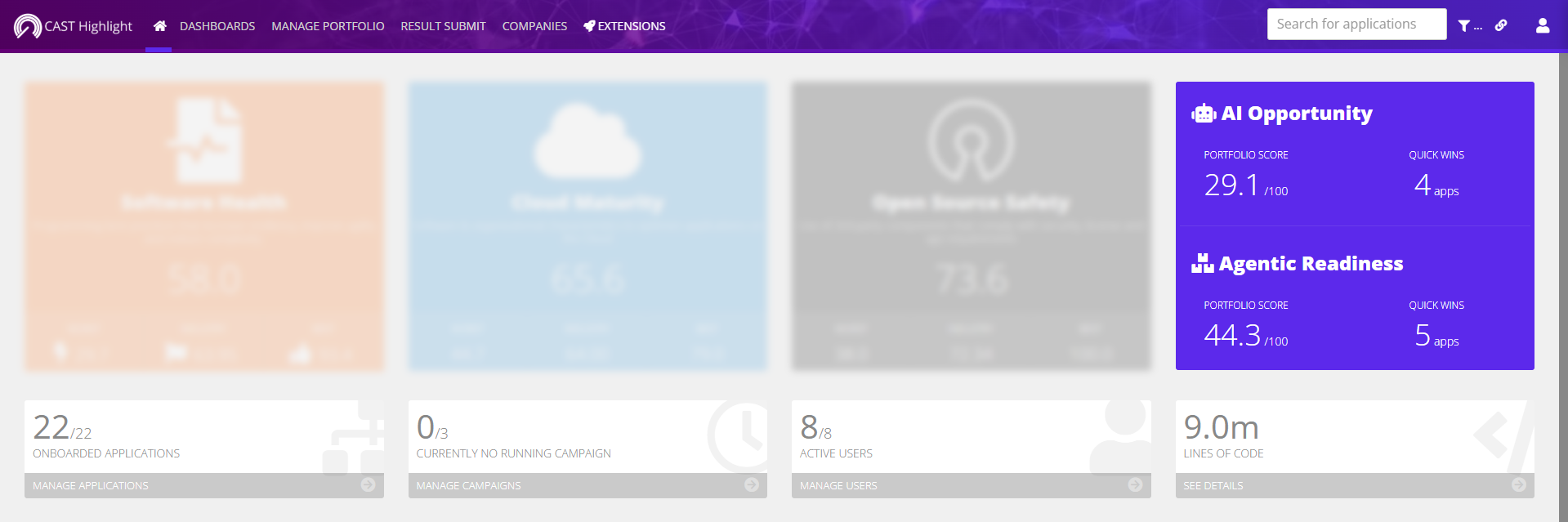
What the Agentic Readiness Score Measures
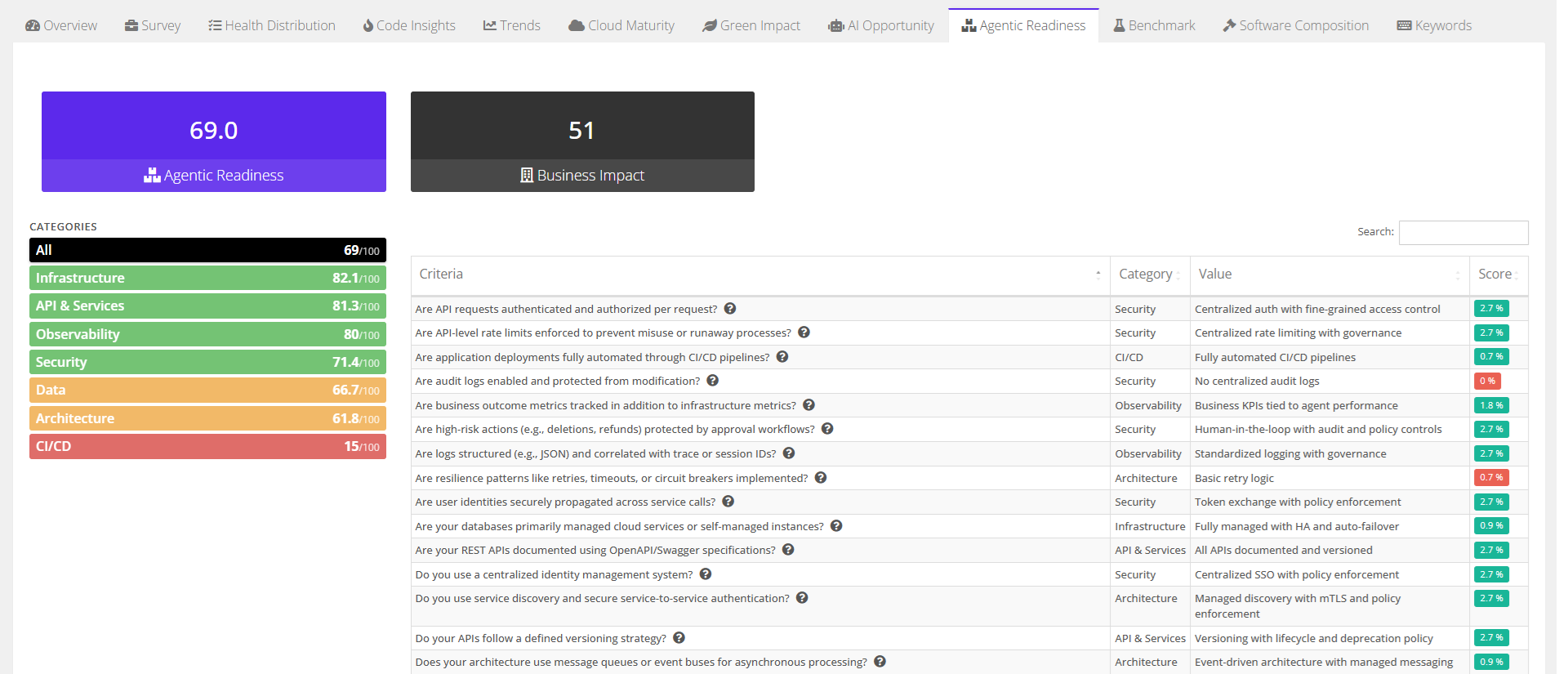
Each application receives an Agentic Readiness score from 0 to 100, calculated across 43 criteria grouped into 7 categories:
| Category | What It Assesses |
| API & Services | Whether APIs are documented, versioned, authenticated, idempotent, and exposed through a managed gateway |
| Architecture | Structural compatibility with agentic patterns, microservices, async messaging, modular design |
| Infrastructure | Elastic compute foundations needed to handle the spiky, unpredictable workloads agents generate |
| Security | The full trust and safety perimeter: least-privilege IAM, per-request auth, secrets management, PII redaction, network segmentation |
| Observability | Distributed tracing, structured logs, LLM cost tracking, SLOs, and anomaly detection |
| Data | Data quality, API-accessible data layers, documented schemas, and vector/embedding store availability |
| CI/CD | Deployment automation, canary releases, rollback capability, and integration testing |
These categories reflect the real technical prerequisites for running agents reliably in production. An agent is only as capable as the application infrastructure it operates within, and gaps in any of these dimensions translate directly into deployment risk, security exposure, or silent failures in production.
How the score is calculated
Agentic Readiness uses Min-Max Normalization at each level – criteria, category, and application – ensuring scores are consistent and comparable across your portfolio.
At the Criteria Level
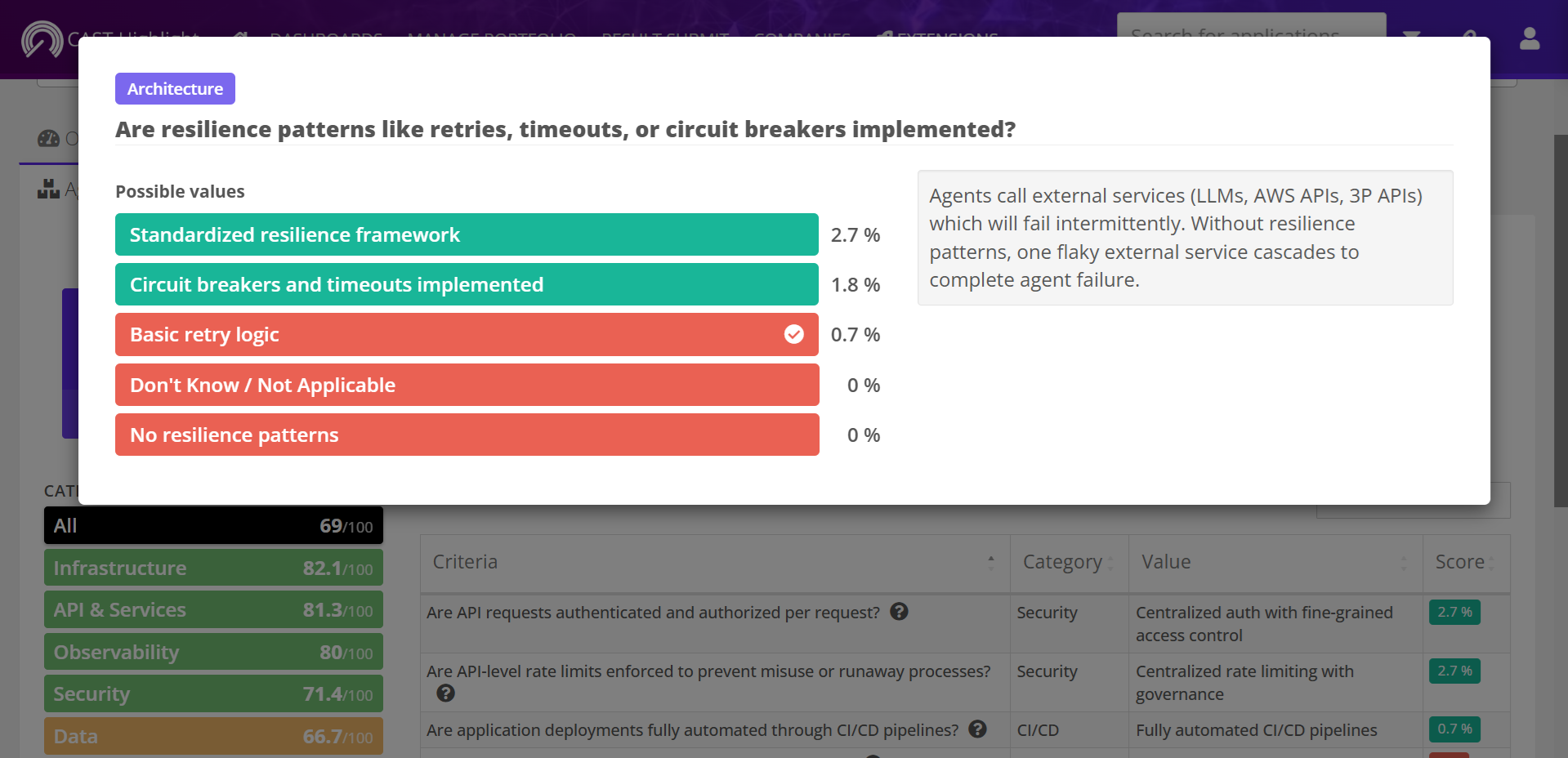
Each of the 43 criteria has a defined set of possible values, each worth a specific number of points. For example, the criterion “Primary API response format” awards:
- Structured JSON with strict formats → 10 points
- Mostly JSON → 5 points
- Mostly XML → 3 points
- Mixed or legacy formats → 0 points
The criteria score is then normalized: Criteria Score = Points Earned / Max Possible Points × 100.
At the Category Level
Criteria scores within a category are summed and normalized against the maximum achievable points for that category. For example, if 5 criteria in the API & Services category can yield a maximum of 40 points and an application earns 25, the category score is 25 / 40 × 100 = 62.5.
At the Application Level
The same normalization applies across all 43 criteria: total points earned divided by total maximum possible points, multiplied by 100. An application scoring 250 out of a possible 500 points receives an Agentic Readiness score of 50/100.
Not all criteria are weighted equally, facts associated with each criterion carry different weights to reflect their relative importance for agentic compatibility
How Criteria Are Evaluated
Each criterion is evaluated through one of two methods, or a combination of both:
- Automated code scan — CAST Highlight analyzes source code using deterministic patterns to evaluate criteria objectively. It currently covers 23 of the 43 criteria (66%) through the code scan, across all seven categories.
- Declared insights (survey) — For criteria that can’t be fully determined from code alone, users answer structured questions about their application’s architecture, infrastructure, and operational practices. These answers are weighted and contribute directly to the score.
This combination ensures the score is both evidence-based (grounded in what’s actually in the code) and operationally relevant (capturing context that code alone can’t reveal).
Portfolio-Level Segmentation
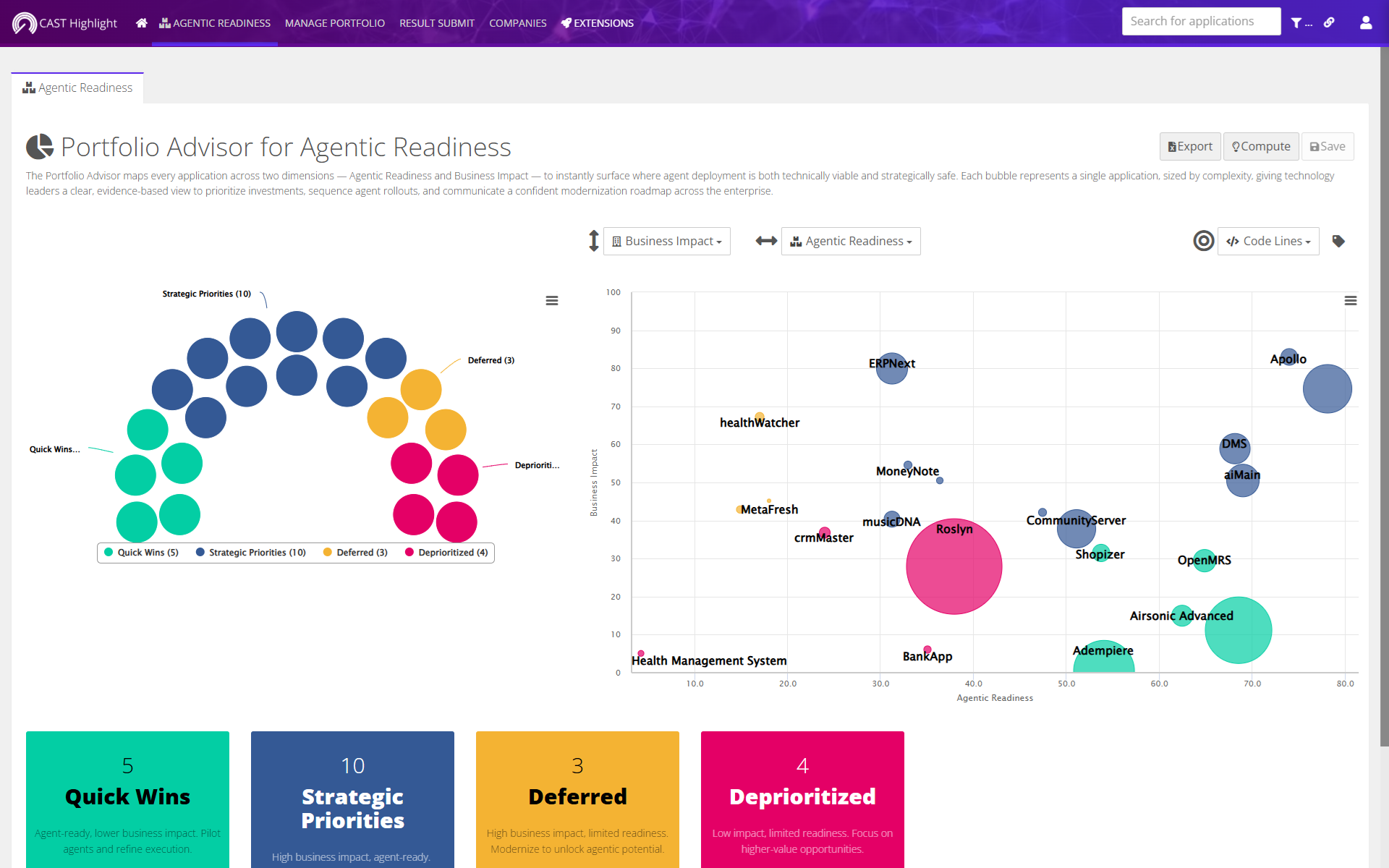
Once every application in your portfolio has an Agentic Readiness score, CAST Highlight intersects it with each application’s Business Impact score to produce an automatic portfolio segmentation across four quadrants:
| Segment |
Agentic Readiness |
Business Impact |
Recommended Action |
| Quick Wins | |||
| Strategic Priorities |
High |
High |
Prioritize and deploy agentic capabilities now |
| Deferred |
Low |
High |
Modernize to unlock agentic potential |
| Deprioritized |
Low |
Low |
Focus on higher-value opportunities |
This gives technology leaders an immediately actionable portfolio map — without manually reviewing each application. Applications with strong readiness but lower criticality become Quick Wins, ideal for early pilots. The highest-value, agent-ready applications surface instantly as Strategic Priorities. Applications with high business impact but limited readiness are flagged as Deferred, with a clear mandate to modernize.
Segment threshold values will be refined over time as real-world portfolio data is observed.
Application-Level Views: From Score to Action
The portfolio view tells you where to focus. The application-level views tell you what to do.
For each application, CAST Highlight provides:
- Category breakdown: A macro view of the score across all 7 categories, instantly revealing which dimensions are strong and which are holding the application back
- Criteria detail: A micro view showing the individual score for each of the 43 criteria, with the evidence behind it
- Improvement paths: For each criterion, CAST Highlight surfaces the possible paths to improve the score, giving engineering teams a concrete, prioritized checklist rather than a vague mandate to “modernize”
This drill-down capability bridges the gap between strategic portfolio decisions and day-to-day engineering work. A team looking at a Deferred application knows exactly which criteria to address, in which order, to move it toward agent readiness
Build Your Agentic Roadmap on Solid Ground
Agentic adoption doesn’t have to be a leap of faith. With Agentic Readiness in CAST Highlight, every investment decision is backed by objective, code-level evidence. You’ll know which applications are ready to support agents today, which ones need targeted modernization, and exactly where to start — across all 7 categories that matter most for autonomous agent deployments.
For organizations serious about capturing the value of agentic AI, the competitive advantage will go to those who move first — and move in the right direction. Agentic Readiness gives you the visibility to do both.
To learn more or get started, visit castsoftware.com
How To Turn This Feature ON
If you have a Complete Insights edition of CAST Highlight, the Acceleration Insights is automatically enabled once you import the Agentic Readiness Assessment survey from the survey catalog. For existing applications, you will have to rescan with a recent version of the Code Reader (5.12.1 or above).